|
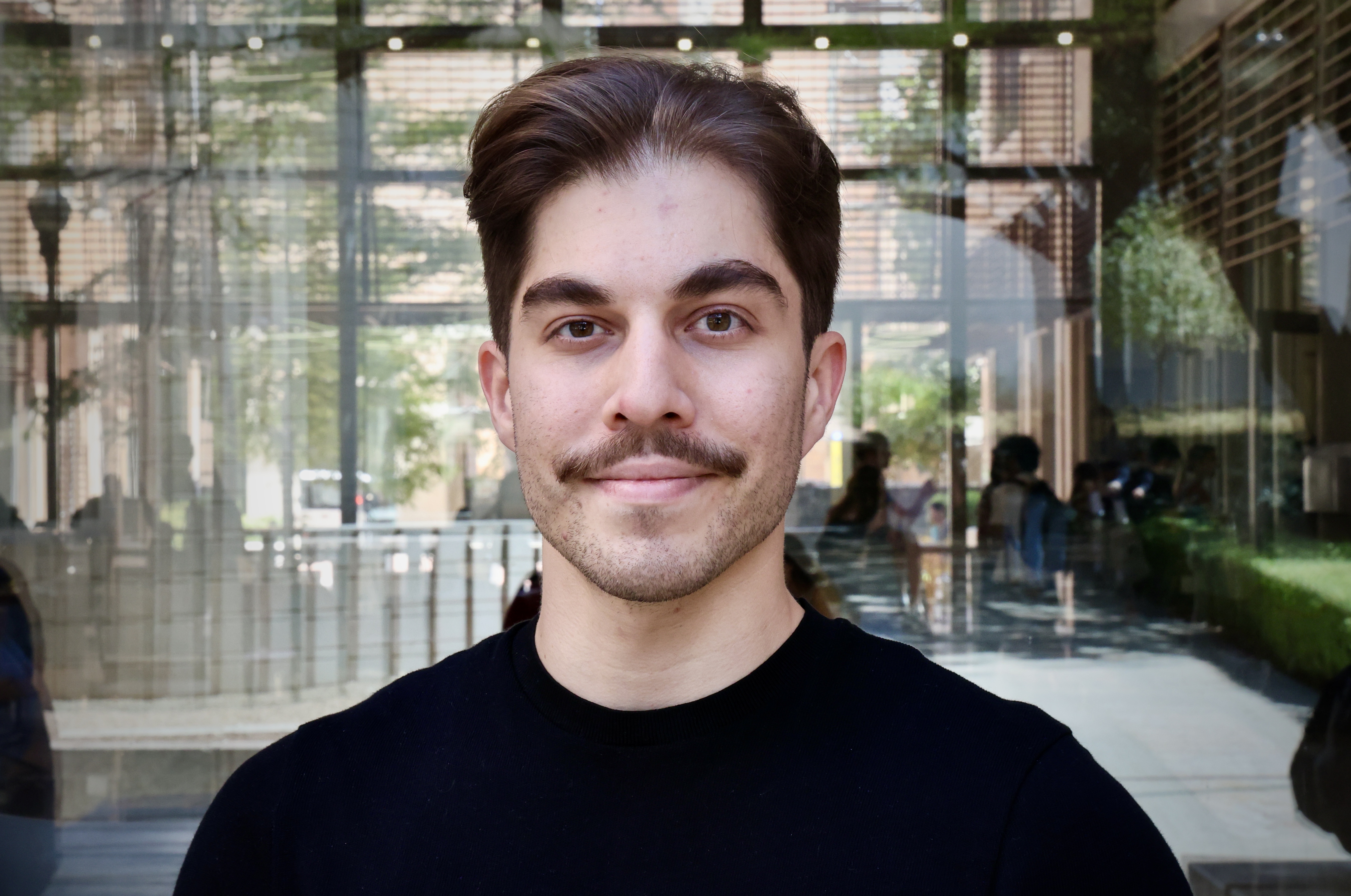
I am a Ph.D. student at the Department of Electrical and Computer Engineering, University of Texas at Austin. I am advised by Prof. Ufuk Topcu. I received my B.Sc. degree from the Department of Electrical and Electronics Engineering at Bilkent University, where I worked with Assoc. Prof. Yildiray Yildiz. Email / CV / Google Scholar / Github / LinkedIn Twitter / Center for Autonomy |
|
News
- Aug 2025: I finished my summer research internship at Bosch Center for Artificial Intelligence!
- Aug 2025: I became an organizer at the Reinforcement Learning Reading Group at UT Austin!
- February 2025: One paper got accepted by L4DC 2025! Dense Dynamics-Aware Reward Synthesis
- Jan 2025: Two papers got accepted by ICLR 2025! Safety-Prioritizing Curricula and Neural SDEs for Offline RL
- Aug 2024: I finished my summer research internship at Honda Research Institute!
- Aug 2023: New journal paper at Artificial Intelligence 2024!
- Aug 2024: Workshops! Gave a talk at RLBRew and presented the same paper at RLSW during RLC 2024!
- Aug 2023: Two papers presented at UAI 2023!: RACGEN and RM-Guided SPRL
- June 2023: New extended abstract at AAMAS 2023!
- Aug 2021: New paper at CCTA 2021!
Research
I do research on reinforcement learning (RL), with a focus on generalization and curriculum learning (CL). My publications can be found on my Google Scholar page, and some are listed with details below. During my Ph.D. so far, I have done research internships at Bosch Center for Artificial Intelligence and Honda Research Institute. At Bosch, I developed CL4AD, the first integration of CL into batched autonomous driving simulators, accelerating training by 77%. At HRI, I developed an action advising framework, Gen2Spec, that distills knowledge from generalist agents to specialists in a continual learning setting. Recently, I have been focusing on the following research directions:
- Risk-aware CL for RL-based Post Training: We develop a risk-aware curriculum generation algorithm for RL-based fine-tuning of language models.
- Conformal Prediction for Uncertainty-aware CL: We adopt conformal prediction for curriculum learning to prioritize tasks with high model uncertainty during post-training.
- Synthetic Curricula for Autonomous Driving: We guide generative models via curriculum learning for synthetic traffic scenario generation.
Curriculum Learning for Reinforcement Learning
The design of task sequences, i.e., curricula, improves the performance of RL agents and speeds up the convergence in complex tasks. An effective curriculum typically begins with easy tasks and gradually changes them toward the target tasks. Common approaches require manually tailoring the curricula to identify easy and hard tasks, which requires domain knowledge that might be unavailable. My research focuses on developing automated curriculum generations algorithms that utilize generative models, introduce notions of risk and uncertainty, address constrained RL, and exploit task specifications.Publications
Cevahir Koprulu, Thiago D. Simão, Nils Jansen, Ufuk Topcu
International Conference on Learning Representations (ICLR), 2025
Cevahir Koprulu, Thiago D. Simão, Nils Jansen, Ufuk Topcu
Conference on Uncertainty in Artifical Intelligence (UAI), 2023
Cevahir Koprulu, Ufuk Topcu
Conference on Uncertainty in Artifical Intelligence (UAI), 2023
Cevahir Koprulu, Ufuk Topcu
International Conference on Autonomous Agents and Multiagent Systems (AAMAS), 2023 (accepted as Extended Abstract)
Workshops
Cevahir Koprulu, Thiago D. Simão, Nils Jansen, Ufuk Topcu
RLBRew and RLSW at Reinforcement Learning Conference , 2024
Exploiting Side Information for Offline and Mixed RL
We investigate use of side information to improve the performance of RL agents offline and mixed (offline + online) settings. For offline RL, we develop an uncertainty-aware, offline model-based reinforcement learning approach (NUNO) with neural stochastic differential equations, levelaraging prior physics knowledge as inductive bias, improving state-of-the-art in low-quality data regimes. For mixed settings, we introduce a systematic reward-shaping framework that distills the information contained in (1) a task-agnostic prior data set and (2) a few task-specific expert demonstrations for dense dynamics-aware reward synthesis.Publications
Cevahir Koprulu, Franck Djeumou, Ufuk Topcu
International Conference on Learning Representations (ICLR), 2025
Cevahir Koprulu, Po-han Li, Tianyu Qiu, Ruihan Zhao, Tyler Westenbroek, David Fridovic-Keil, Sandeep Chinchali, Ufuk Topcu
Learning for Dynamics and Control (L4DC) Conference , 2025
Learning Reward Machines and Policies
We study the problem of reinforcement learning for a task encoded by a reward machine. The task is defined over a set of properties in the environment, called atomic propositions, and represented by Boolean variables. One unrealistic assumption commonly used in the literature is that the truth values of these propositions are accurately known. In real situations, however, these truth values are uncertain since they come from sensors that suffer from imperfections. At the same time, reward machines can be difficult to model explicitly, especially when they encode complicated tasks. We develop a reinforcement-learning algorithm that infers a reward machine that encodes the underlying task while learning how to execute it, despite the uncertainties of the propositions' truth values.Publications
Christos Verginis, Cevahir Koprulu, Sandeep Chinchali, Ufuk Topcu
Aritificial Intelligence, 2024
Level-k Game Theory to Model Human Drivers
Level-k game theory is a hierarchical multi-agent decision-making model where a level-k player is a best responder to a level-(k-1) player. In this work, we studied level-k game theory to model reasoning levels of human drivers. Different from existing methods, we proposed a dynamic approach, where the actions are the levels themselves, resulting in a dynamic behavior. The agent adapts to its environment by exploiting different behavior models as available moves to choose from, depending on the requirements of the traffic situation.Publications
Cevahir Koprulu, Yildiray Yildiz
IEEE Conference on Control Technology and Applications (CCTA), 2021
Cevahir Koprulu, Yildiray Yildiz
ArXiV, 2021